My Personal “Take” on the Global Faith and Work Movement
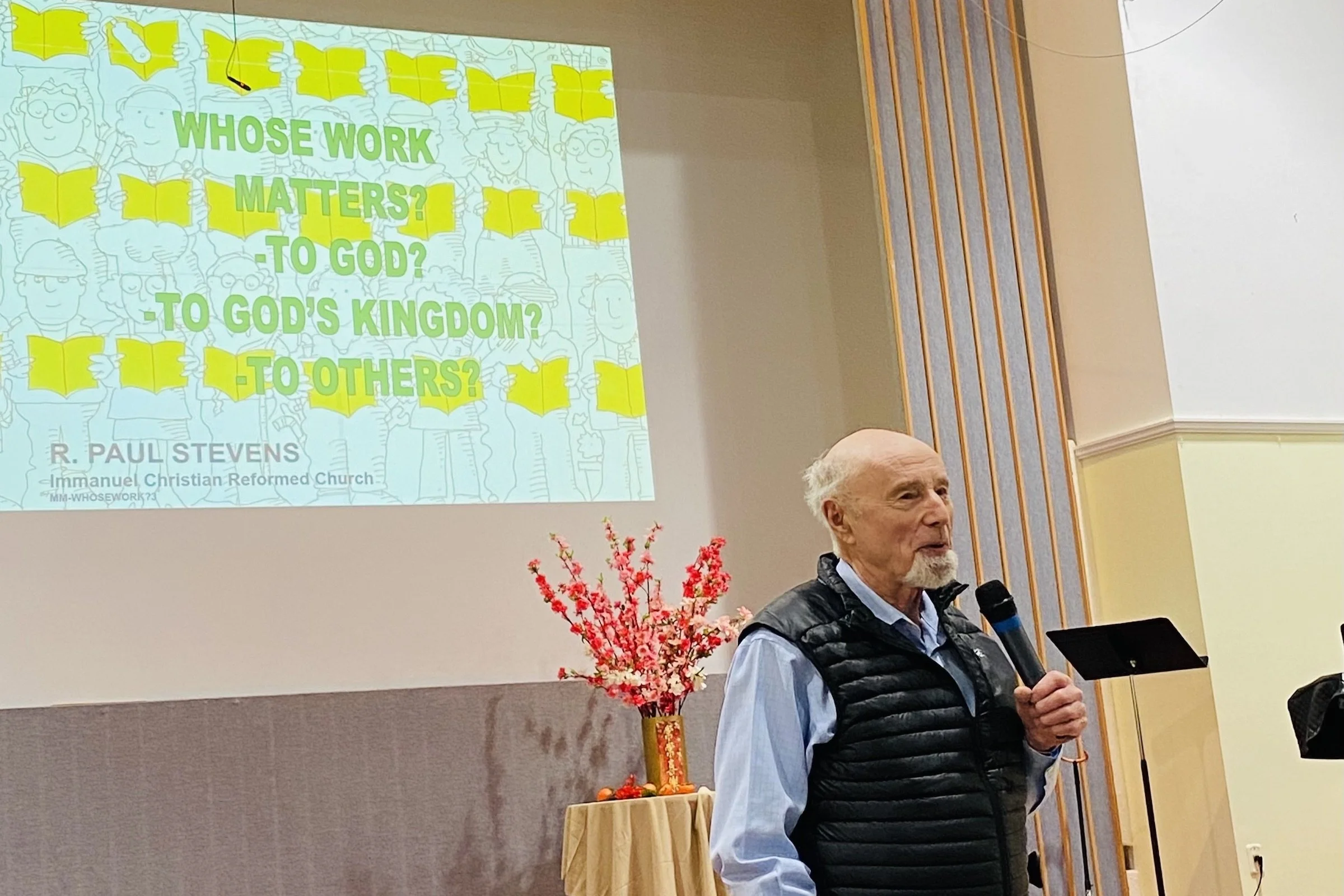
I am 88 now, soon to become 89. So it is not too soon to do some reflection on the second half of my life, given as it has been to nurturing, expediting, theologizing, and using every opportunity to expand the influence of faith and work integration, in a word, to put dualism to death. But to be honest my life of following Jesus did not start that way.
It started with an absolute commitment to the whole people of God, the so-called laity, being called, equipped and commissioned by the Lord himself to the work of ministry in all of life—home, church, workplace and neighbourhood. I wanted to develop a down-to-earth spirituality of everyday life. Indeed the first Christian book given to me by the tiny underground church in Edwards Hall men’s residence of MacMaster University was Brother Lawrence, The Practice of the Presence of God. This was ten days after I was apprehended by Jesus in a prayer retreat which I was leading. From that encounter with the Lord, I became mired in a delightful but confusing vocational chaos as I felt called to what I thought would be pastoral ministry or missionary service, not to become a teacher of geography and history to which I had advance registered. But I soon realized from my study of Ephesians 4:11-12 that God, under the New Covenant in Jesus called everyone to “full time” ministry! And the ministry of the so-called laity was primarily in the world as Christ calls his people to “fill the universe” (Eph 4:1) with his glory and his sovereignty. So, as I said, I did not start with the faith at work movement but with the laity movement and therein I encountered a fascinating question which I will take up shortly. But first I must confess an amazing discovery echoed by one of my favourite authors.
“Christianity is in a profound sense the end of all religion.” Alexander Schmemann[1]
In that first year of following Jesus I discovered that I had not joined a religion but joined Jesus in the Way. I was part of the disciple community. I was in the kingdom of God. In my second year at university, I met the woman who would become my wonderful bride. Gail felt called to be a missionary. And I did too. So we checked out the Baptists and found they were working in Africa, Bolivia and India. While we first thought we were going to Bolivia they said we were needed in India. But then they said we were too young, and we needed to get experience in ministry in Canada. So we got called to a mission church in the heart of Montreal even before I finished my theological studies. Gail, a nurse, a counsellor and life companion has travelled with me almost everywhere, often in 4 wheel drive vehicles on no roads in Africa, and contributed to my life and to the kingdom of God in ways that cause my heart to thank God over and over. She was also mother to our three children, eight grandchildren and when she died almost five years ago, she was great Great-Nanny to two of our now six great grandsons. But she had her own ministry: hospitality, counseling, starting a Bible study among UBC family women. And so I wrote on her tombstone, “Their deeds will follow them,” (Rev 14:13). Which they will.
But what is the question to which I have alluded?
Enter the London Institute
There was an unpublished discussion document produced by the London Institute for Contemporary Christianity, started by John Stott in England, which made the profound, but irritating suggestion that it was because of the failure of the laity movement that the faith and work movement was born and began to thrive. The author, whoever he or she is, traced what everything has happened to the lay ministry movement from “Rebirth” (1962), to “liberation” (2004), to “Abolition” (2006). He (or she) traced the progressive loss of terminology from the “Apostolate of the Laity” (an early Roman Catholic term in which lay people take the light of Christ into all the dark places in the world), to the “Ministry of the Laity,” to the “Ministry of Daily Life” (I was a part of that in the mid-70s), and finally to “Marketplace Ministry.” “It is my suggestion,” said this unidentified author, “that this downgrading of terminology reflects a dissipation of hope within the [laity] movement and represents a fundamental shift of emphasis from person to place,” or so they suggested.[2]
That story is actually written in the list of books I have authored, surprisingly to myself because I never thought I would or could write a book. And perhaps I have written too much. But I recite this list to illustrate the change taking place in myself, from advocate for the whole people of God to becoming an advocate for a piece of the ministry of the whole people of God not so much in the church as in the marketplace.
• Liberating the Laity (1985)
• Married for Good (1986)
• Marriage Spirituality (1989)
• The Equipper’s Guide to Every Member Ministry (1992)
• The Equipping Pastor (1993)
• New Testament Spirituality (with Michael Green) reprinted as Living the Story (1994)
• The Complete Book of Everyday Christianity (with Robert Banks, 1997)
Then there was a shift.
• The Abolition of the Laity, Vocation, Work and Ministry in Biblical Perspective (Paternoster), printed in USA under the less offensive but innocuous title, The Other Six Days (1999).
• Seven Days of Faith (2001/2021)
• Down-to-Earth Spirituality (I think this is my best book, based on Jacob; it took 40 years of brooding on the text to write it and I embedded work and calling in a book on spirituality, 2003)
• Doing God’s Business: Meaning and Motivation for the Marketplace (2006)
• Taking Your Soul to Work (with Alvin Ung, 2010)
• Work Matters: Lessons from Scripture (2012)
• Entrepreneurial Leadership (with Rick Goossen, 2013)
• Aging Matters (2014)
• Money Matters (with Clive Lim, 2021)
• The Kingdom of God in Working Clothes (2022)
• Working Blessedly Forever Volume 1: The Shape of Marketplace Theology (2024)
• Working Blessedly Forever Volume 2: The Practice of Marketplace Theology (2025)
• Working Blessedly Forever Volume 3: The Spirituality of Marketplace Theology (2025)
• Entrepreneurship: A Christian Perspective (revamping an earlier book with Richard Goossen (2026)
Back in 2022 I used to say (and secretly prayed) that I might last three more years to finish the trilogy. Now, in spite of being down to one working eye and some other old age ailments, we are in 2026. I am still alive and going strong. But the change in publishing is significant.
It is also reflected in the courses I have taught mainly at Regent College (a school for the whole people of God) but also extensively in some of 28 countries of the world I have visited.
• Vocation, Work and Ministry
• Foundations for Pastoral Ministry 2
• Christian Education and Equipping
• The Equipping Ministry
• Preaching
• Preaching the Revelation
• Everyday Life (The Christian Life)
• Servant Leadership
• Theological Education Overseas
• Ministry and Spirituality (with James Houston)
• Tentmaking
• Lay Ministry Development
And, again, there is a shift in what I was teaching in later years. If I could place a time when the shift took place it was the year (approximately 1989) that Peter Mogan, a local lawyer with whom I taught joined me. We changed the name of our course, “Lay Ministry Development” to “Marketplace Ministry and Theology.” We thought we had struck gold.
• Marketplace Ministry and Theology
• Down-to-Earth Spirituality
• Traveling Marketplace Seminar
• Theology of Work
• Taking Your Soul to Work (with Alvin Ung)
• The Soul of Entrepreneurship and Innovation
• Head, Heart and Hands: Theology and Practice of the Crafts
• Marketplace Mission
• The Church and the Marketplace
• Aging Matters
• Money Matters
• Doing God’s Business
• Working Blessedly Forever
• Marketplace Pastoring
• And this past fall, returning to my first concern, The History of the Christian Laity
What happened? And why did it happen? And what does it mean?

Have I given up on the church or what? For certainly at least in the West, and more particularly North America, the faith and work movement has almost completely bypassed the church or the church has bypassed the movement. There are, however, some important exceptions, including Redeemer Church with Tim Keller in New York and the tremendous work of Tom Nelson in Kansas. But it is not only the church that has been bypassed. The movement has bypassed the trades and blue collar people (again an important exception in the life, work and writing of David Hataj, a machinist), women and minorities. And, critically important, it has bypassed the spirituality of work, worker and workplace.
But in my first church back in 1961 I was still trying to unleash the whole people of God, believing as I did and do that there are no laypersons in the usual sense of the word in the church but that the church is full of clergy that is ordained, blessed and commissioned (to explore this further biblically read my The Other Six Days[3]. I was ordained in Temple Baptist Church in Montreal because at that time in Quebec you could not marry a couple or bury the dead without being a Reverend. But the ordination council that preceded the actual ordination service, had as its purpose to hear my call to ministry and my beliefs. It was a committee composed of half laity and half clergy (in the common sense of these words). I said, “I am called to ministry but everyone in Christ is so called. It may be my privilege to spend a few years being supported by this church but (I said prophetically) I may not always be supported. Indeed I might work in the world but I will still keep ministering. And please do not call me Reverend. That is a term that should be reserved for God.”
The clergy in the committee were furious and the laity loved it. I was ordained on a fifty-one per cent vote! Thankfully I cannot use the term “Reverend” now because I have been defrocked (delisted) twice for institutional (denominational) reasons not for moral reasons. So I am like John Calvin the famous Reformer who said of himself “I am a layman.” Yes, I am a layman. But I do not believe there is a laity in Christ. We are all ordained through our baptism, as early Baptists practised by the laying on of hands for commissioning as the person emerged from their watery grave to serve Christ full time. The church has no laypeople in the usual sense of that term (unprofessional, second class) but it is full of clergy in the true meaning of that word (commissioned, blessed and honoured). This becomes especially clear when you consult the original Greek. Laikos, the word for “layperson” is never used in the New Testament to describe a Christian. And the word for “clergy” kleros is never used exclusively to describe church leaders.[4]
My work story is chaotic but full of life:
An inner-city church pastor and missionary to a multicultural area of Montreal
InterVarsity Christian Fellows staff worker in the Maritime provinces of Canada and then in Vancouver, BC.
Pastoring a student church in Vancouver
Apprenticing as a carpenter and eventually buying into the business (while planting a street church)
Four more years pastoring another student and young working people church
Accidentally becoming a professor at Carey Theological College (I said to the then president, “You don’t want me.” He asked, “Why?” “Because I am too controversial.” “That’s why I want you,” he replied. “You are a maverick and we need a maverick here in academia.”) The academy is one of the most conservative institutions in the world and very resistant to change.
The year following I became professor at Regent
Two years later I became the academic dean (7 years in total as dean)
Returned to faculty and started the Regent College Marketplace Institute
Spent ten summers in East Africa doing a creative piece of education and spending two thirds of my time (and my wife’s time) outside the classroom visiting students in their work, ministry or home situation.
Retired from Regent at 68 years of age to make room for younger people but continued to teach and travel extensively wherever students had gone
But in 2014 something auspicious happened.
An Email that Changed Everything.

Dr. Dae Kyung Lee
Dr. Dae Kyung Lee, an oral surgeon in Seoul, and a Regent grad wrote me (Stevens) an email that he was praying about a vision: “An Institute (or school) for Christian Life (Bible and Marketplace Institute) with you as President. I am wondering if you are able to be part of the plan. Possible location: Jeju Island, South Korea. Main language: English, with consideration of Chinese and Korean translation.”
DK, as he is affectionately now called, envisioned a building on visa free Jeju with three main areas of teaching (Bible, spirituality, and marketplace theology), with intensive and weekend courses, a board composed of Regent grads, some people who could provide finances and people with theological knowledge and spiritual discernment, some from China, Korea, Canada, and USA. DK’s vision for a sustainable institute involved fund-raising for land, building and other facilities and tuition and business profit for operation expenses.
“Are you interested?” he asked. I was. Retiring from Regent but with 45 years of teaching, publishing, modelling, and advocating for the marketplace, I had always dreamed of an institute and had started the Marketplace Institute at Regent, which was taken over by my successor, Paul Williams. But I was 77 years of age (“Am I crazy to be starting something at this age?” I asked. My physician and my accountability group encouraged me to “keep engaged.”)
IMT (The Institute for Marketplace Transformation) is now in seven soon to be nine regions of the world: China and Taiwan, Hong Kong, Korea, South-East Asia, North America, Brazil, South, East and West Africa, with some insipient regions emerging. We concentrate on training the trainers (mainly through intensive Fellows groups of twelve people or less), publications, partnerships with churches and other organizations and producing videos. We are essentially an educational mission.
Has the Church Really Been Bypassed?
To be honest, there are some encouraging signs from the rest of the world that the church is involved in the marketplace ministry movement. Years ago a course on theology of work was taught in Seattle by Bakke Graduate University for 18 people. These people fanned out into the world, but mostly to Africa. There is now some 80,000 people in Africa alone, mostly pastors who have taken a week-long course on the theology of work and applied the teaching to their people. Africa with its 800 million followers of Jesus is ready and more than willing to hear the message and to apply it. It could become the centre of the Christian world. Many if not most of the people in South, East and West Africa doing integrative training are pastors.
The Theology of Work Project has produced a commentary on work in every book of the Bible that enables global pastors not to skip over, as they often do, what the people of God are doing Monday to Friday. In Asian and Chinese speaking seminaries, marketplace courses and courses in everyday life spirituality, are being offered for example in Taipei, Toronto, Hong Kong and Singapore (through Biblical Graduate School of Theology modelled after Regent). Also in South America there are faith at work movements, some of them involving pastors and churches such as Vocatio in Brasil.
Meanwhile in North America where it is forecast that in the next ten years 80% of seminaries will either close or merge (to survive) there is a crying need for the reformation of theological education and I want to be part of it. Indeed revival is coming. There are some models of a new way of educating people for their life in the world or the church, or both. Theological education at its best is too good to be reserved for the clergy. At Regent I once told the president that it costs a quarter of a million dollars to get a two year theological degree at Regent. “You are crazy,” he said. But I had him count it up: tuition, housing, food, transportation, books and lost salary. It is even more when a doctor or a lawyer comes for two years. So under his leadership Regent invented a two year theological degree (MALTS: a MA in Leadership, Theology and Society) that has several factors: (1) cohort-based, not cafeteria based—the same people start and finish together; (2) twice a year for two weeks they take two intensive courses on the Regent campus face to face; (3) they are mentored in between; (4) they do not have to quit their jobs; (5) they produce a capstone project often related to their everyday work; (6) it is done mostly with brilliant sessional lecturers (who cost a whole lot less than tenured faculty) mostly from the marketplace but fit to teach theology; (7) it financially sustains itself. I have other thoughts on how theological education can be reformed. Meanwhile institutes such as HKPES in Hong Kong and Graduates Christian Fellowship in Malaysia are flourishing. So while Africa and Asia are thriving the church in North America is, by and large, diminishing. Faith and work has largely bypassed the church.
Europe, the one-time centre of the Christian world, is now in serious decline. Post-Christian is a fair term. While here and there, with the exception of the London Institute and several other bright lights, including the Imagine Pastors movement, and IFES (International Fellowship of Evangelical Students), a few lay institutes, and a few whole life discipleship churches, Europe maintains its cathedrals as tourist attractions. Years ago in 1956 George MacLeod of the Iona Community penned something profoundly true, hinting as has more recently been suggested, that in North America renewal to the church can come in part from the faith and work movement.[5]
I simply argue that the cross be raised again at the centre of the marketplace as well as on the steeple of the church. I am recovering the claim that Jesus was not crucified in a cathedral between two candles, but on a cross between two thieves, on the town garbage heap, at a crossroad so cosmopolitan they had to write his title in Hebrew, Latin and Greek. It was the kind of place where cynics talk smut, thieves curse, and soldiers gamble. That’s where he died. And that’s where Christians ought to be and what churchmen [sic] ought to be about.[6]
But who can stop the lovely movement of God in the faith and work context as it grows globally through thousands of organizations, institutes, a few seminaries and some local churches. It is a Spirit initiated and Spirit empowered movement without a single human leader. As Gamaliel, one time mentor of the Pharisee Saul, who later became the apostle Paul, said of the infant kingdom of God movement in Acts 5:38: “Leave these men alone! Let them go! For if their purpose and activity is of human origin, it will fail. But it is from God, you will not be able to stop these men; you will only find yourself fighting against God.” And you, dear reader can be part of it, or are so. This is a God-movement without a single human leader. But if, as I have claimed the movement tends to be superficial we must ask how we can go deeper with God in the faith and work movement.
Going Deeper

Integration
Much of the faith and work movement tends to concentrate solely on evangelism in the workplace, practising ethics in work or is focused on solely intellectual and academic concerns. What is needed is wholism, shalom, or in a word, integration. But what is integration? Integration is living consistently, completely, wholistically for God in all the complexities of everyday life in business, family, neighbourhood and society. It is living with the “single” or “heathy” eye through which the whole bodily life is illuminated and transformed into ministry and worship (Luke 11:33-6). It is the opposite to living life in compartments, or silos, living piecemeal in a fragmented world, living a bifurcated life, living as Dr. Jekyl and Mr. Hyde—one person in church and another in the workplace. Integration is fundamental to the Christian life and takes us to the heart of God’s purpose “to bring all things in heaven and on earth under one head, even Christ” (Eph 1:10). It is often thought that integration is simply considering Christianity and something like politics, business or work. But what if Christianity is the “and”? And one of the reasons we emphasize faith and work is that if can successfully integrate in this area of our life, where we spend most of our waking hours, we have a spitting chance of integrating the rest of our everyday life. But there are some biblical assumptions behind and within integration.
The whole created order subsists in Christ. “In him all things hold together” (Col 1:17), a verse memorialized (in Latin) on my university’s crest. The creation will experience its final transformation when Christ comes again and declares “I am making everything new” (Rev 21:5). As a sign of this coming Sabbath of the entire universe, visible and invisible, Christ claims to be Lord of the Sabbath (Mark 2:28). As a further sign of this coming Sabbath Christ demonstrated his lordship by bring wholeness, healing, and shalom on the Sabbath, a foretaste of the final threefold harmony of God, creation and humankind. But there is more.
There is no unity, no final integration outside of Christ. What there is outside of Christ in the so-called secular world is dull uniformity, alliances and autonomous collections of people like that demonstrated in the tower of Babel, not the rich perichoretic (interpenetrating) social unity of the Father, Son and Holy Spirit, expressed in unity through diversity, on the Day of Pentecost. But further.
Truth is finally and completely found in Christ who claimed to be “the way and the truth and the life” (John 14:5). This affirms that the truth about him and about life will be discovered through obedience, through life itself, which as Matthew the Poor has said so aptly, “Life is but one single way to the kingdom of God.”[7] Truth will therefore be more than but not less than cognitive propositions. It will be discovered in praxis and dialogue and not exclusively in rational discourse. Luther once said that it was “living, even by dying and being damned, make someone a theologian, not understanding, reading and speculating.”[8] But Christians do not have all the truth—yet. We are always on the Way. But integration happens when we find the points of congruency between biblical revelation and God’s truth revealed outside of the Bible, welcoming the dialogue but keeping the dialogue under the redemptive authority of Scripture. So the attempt to discover and foster integration can be meaningful and a form of loving God with our heart, soul, mind and strength (Mark 12:30-31).[9] The heart is the spirit, the inner person. The soul is the capacity of the will and emotionality. The mind is reasoning. Christ does not destroy reason but he does dethrone it. Strength is energy, praxis and action. Jesus addresses all four: “Do you love me?” (heart, John 21:16); “Follow me” (soul, Mark 2:14); “Who do people say the Son of Man is? What about you? (mind, Matt 16:13-4); “See to it, then that the light within you is not darkness. Therefore if you whole body [bodily life] is full of light, and no part of it dark, it will be just as full of light as when a lamp shines its light on you” (strength, Luke 11:35-6). Al Erisman and Randy Pope have written about this masterfully in Living with Purpose in a Polarizing World.[10] So much for the theology of integration; now for the practice.
2: Deeper Integration Internally: Head, Heart and Hand
In his PhD Thesis David Miller developed a matrix which I have modified to express how the faith and work movement and those who lead, teach, mentor and model, need to integrate faith and work in more than one way. In my model I use four “Ms”: Meaning (for theology-head); Mission (hand); Mysticism for spirituality (heart); and Morality or ethics (heart). Lets start with meaning.
Meaning: Actually, relatively few people integrate faith and work theologically. It is mostly done, though seldom, in the seminary or the academy, though sometimes it is done well by self-educated persons. Theology needs to be done “from above,” that is, starting with the revealed principles of Scripture and wrestling with application; this latter action is unfortunately often not done. An example of the great themes of the Bible as a starting point can be found in the “Introduction” to my book Work Matters.[11] Personally I prefer the biblical teaching on the kingdom of God as a wholistic and integrating theme of the whole Bible, and especially since Jesus who spoke of it over 144 times. It was his master thought. Jesus began and ended his earthly ministry with teaching on the kingdom. Virtually all of the parables are about the having come and the coming kingdom, the now and not yet.[12] So doing theology from above involves doing the theology of work, worker, and workplace.
But theology needs also to be done “from below.” This entails starting with a life situation, a problem, or an experience and wrestling with it in the light of biblical revelation until you have found a way to embrace that truth or act on it. Some examples of doing theology from below in Scripture itself are Job, Ecclesiastes, and some of the Psalms. See also the elaboration of this way of doing theology in Working Blessedly Forever.[13] Theology brings meaning.
Mission: This is a second way we integrate faith and work, and here we have a large problem. While it is true that the marketplace is probably the most strategic mission field in the world today, what with the access people have to it, the issues raised in the marketplace, and the fact that most people spend the largest chunk of their waking hours there, the marketplace is more than a platform for mission, especially for evangelism. But the marketplace itself is part of the mission of God, what God wants done in the world.[14]
So I contend that there are three commissions in the New Testament, beginning with the Great Commission (Matt 28:19-20)—making disciples of all nations. But there is, in my view, a Greater Commission when Jesus responded to the reading of Isaiah 61 in his home synagogue (Luke 4:16-21). That passage describes a mission that is economic, personal, social—liberating captives, redemptive in providing favour and fellowship with God, plus empowering people to a universal priesthood and finally work (Isa 61:1-7). Jesus responded to the reading with “Today this is fulfilled in your hearing.” God’s mission, of which Jesus is the ultimate missionary, is wholistic, integral. But, in my view, a third commission which I call the Greatest Commission is fully incarnational.
One of the last words of Jesus to the disciples is found in John 20:21: “As the Father has sent me [with all the resources of the Triune God], I am sending you [in a total life incarnational mission].”[15] It is possible to fulfill the Great Commission without bringing about whole-life discipleship to Jesus. But this whole life discipleship is implied in the statement “Teaching them to obey everything I have commanded you” (Matt 28:20). So mission is the second way we integrate faith and work. But the third way we must integrate faith and work is in morality (ethics).
Morality (ethics): As suggested above in the stunning remark of George MacLeod about where Jesus died, the marketplace involves global dimensions, economic factors—involving exchanges of money and goods/services—relationships (because business is based on trust), plus the invisible forces and personages which Paul calls the principalities and powers. These powers were originally created good by Christ (Col 1:16) but have become intransigent, taking on a life of their own (though Christ overcame them and showed their puny power, disarming them through his cross (Col 2:15). In a word, the marketplace is messy. Business is business and the church and church work is different, so many think. Not so. Both the church and the marketplace are messy. Both are complicated regions in which to work because of sin. How can a business in the messy middle (the overlap of the new age and the old age) glorify God? It can through integrity—financial, relational—and purity of product and service. Integration requires ethics. And ethics can be done through the four Cs: commands (deontological, like the Ten Commandments on which David Gill has written an excellent resource[16]), consequences (teleological, what the end or outcome of the action would be), character (often called virtue ethics and again David Gill has an excellent resource based on the Beatitudes[17]) and communion with Christ and keeping in step with the Spirit. On this last point Jesus offers that the Spirit will give us the words to say [or the action to take] when needed (Matt 10:16-20).[18] So ethics can be both creative and beautiful. But finally there is mysticism or spirituality.
Mysticism: Spirituality is simply direct contact with ultimate reality (God). P.T. Forsyth in his masterful The Soul of Prayer says that “prayer is to the religious life (sic!) what original research is to science—by it we get direct contact with reality.”[19] But this is the missing dimension in almost all attempts to integrate faith and work. That point was well made in an article in Christianity Today by Jeff Haanen who points out:
The faith and work movement has been geared toward power and cultural influence, but the future of the movement, I believe, will be rooted in spiritual formation. Work is not only about success, influence, or even gospel impact—it’s about who we are becoming as followers of Christ.[20]
So I devoted a full volume of the trilogy Working Blessedly Forever to spirituality. But spirituality is hard to define. I find the best definition comes from South America, from Segundo Galilea:
All spirituality springs from this fundamental fact of a God who loved us first…. If Christian spirituality is, before all else, an initiative by and a gift from God who loved us and seeks us, spirituality is then our recognition and response, with all that entails, to this love of God that desires to humanize and sanctify us. This path of spirituality is a process, concrete but never finished, by which we identify ourselves with God’s plan for creation. Because this plan is essentially the Kingdom of God and its justice (holiness), spirituality is identification with the will of God for bringing this Kingdom to us and others.[21]
In terms of spirituality, integration means several things: (1) Work is actually an arena for spiritual growth; the issues and troubles, even the works of the flesh inspire a silent or spoken prayer for the fruit of the Spirit.[22] (2) The workplace can be a place of fairly continuous prayer, “pray without ceasing” (1 Thess 5:17). Brother Lawrence, The Practice of the Presence of God was my first Christian book. (3) We work with the Father, the Son and the Spirit (who is working through our work (Psalm 127). Therefore work becomes a form of worship of God as we rule as sons and daughters of God in bringing in his kingdom partly through work. (4) Work is a sacrament in which we can experience the grace of God in provision, in purposeful living, in God’s surprise interventions in the workplace. (5) But finally work can become a transparency through which we see partly and dimly God at work and God himself in what Christians have from time immemorial called the beatific vision. Jacques Ellul puts it bluntly and enigmatically when, in effect, he says if we do not work how would we know that God is still working (John 5:17)?
3: Deeper Integration Externally: On Developing a Marketplace-Friendly Church

Let’s start with an amazing truth. In the Old Testament book of Numbers Moses was a typical one person pastor, ministering all by himself and he was struggling. God said to Moses that there is a solution. God advised Moses to take seventy elders, to share his ministry with them, and for God to commission them by taking some of the Spirit on Moses and putting it on them. But two of the elders missed their ordination service. These two elders, Eldad, and Medad, had not gone to the tent of meeting where the big event was happening but were prophesying out in the camp where people were bargaining and bickering. And a young man rushed to Moses and said, “Eldad and Medad are prophesying in the world not the tent of meeting.” And Joshua, Moses’ aid, said “My Lord stop them.” Moses said, “Are you jealous for my sake? I wish that all the Lord’s people were prophets and that he would put his Spirit on them” (Num 11:21-30, italics mine). God did this through the outpouring of the Holy Spirit on the day of Pentecost as Jesus gave his power and presence to the whole people of God (Acts 2:1-41). I am for Moses. The Spirit is not only personal but universally given, and given for the whole of life in this world.
Earlier we have lamented the dearth of resources for labouring people, for tradespersons, as well as immigrants and women. But the most daring omission from the faith and work movement, especially in the West, is the church. In the forward to my book The Kingdom of God in Working Clothes, Tom Nelson starts with his own confession. Briefly, he said that he had committed pastoral malpractice, not morally, but in terms of not dealing with the location of the people of God Monday to Friday. To that end we have included two chapters on the church in Volume 2 of Working Blessedly Forever. The first is “Forming a Marketplace-Friendly Church (chapter 14), which I wrote out of a lifetime of concern for the making the connection, a lifetime of matchmaking of faith and life that started with my first book, Liberating the Laity. I have since added many chapters to my experience, advice and proposals for making the local church missional in the full sense of that word.
But there is a second chapter in Volume 2 in which my friend Andre Chen who was a CEO of a clothing company in China describes his experience in planting marketplace churches (chapter 15). This chapter alludes to a fascinating article published by Matthew Kaemingk in which he researched the quite extensive remarks of the great missiologist Lesslie Newbigin on the mission to the modern workplace. In that article Newbigin said the church must be local in the real meaning of that word, possibly located actually in the marketplace, using marketplace terminology, having marketplace pastors, and addressing the real issues of the marketplace.[23] This chapter (15) in Volume 2 is a fascinating read, though, as you might expect, Chen who has actually planted churches in the marketplace does not report on a problem-free church. For what church is problem-free? But I have a few words for pastors, having been one for twenty years.[24]
(1) Spend a half day every week in the workplace of one or two of your members. Offer to pray silently for them and over coffee breaks or lunch discuss the meaning of what they are doing, the issues and the presence of God in the workplace.
(2) Interview an ordinary member of the church in the weekly service, not a returned missionary or a visiting clergyperson, and ask them what they do for a living, what are the issues they daily face, and how their faith helps them. Then pray for them for their ministry in the workplace. It takes five minutes.
(3) TTT—This Time Tomorrow. Weekly say, what will you be doing tomorrow at this time? And pray for the workplaces and homes of the gathered church when they are dispersed.
(4) Recognize that many of the issues in the workplace are not black and white but grey. Do not oversimplify.[25] I well remember a young man who started a small marketing company with the idea that there would be a huge area of black, a huge area of white, and a small area of grey. He soon discovered that the grey area was the largest!
(5) Consider taking a season of your life, as I did, either part-time or full time in the workplace outside the church. It will be good for your own soul and certainly good for the church. Here is what it did for me during the seven years of my apprenticeship: a) it confirmed that God is just as much in the workplace as in the church building; b) it gave me most days a sense of accomplishment (“Today we framed the first floor of a new home”); c) I came to appreciate how hard most people have to work and how little time they have for the gathered life of the church; d) I discovered that work is a gift (Eccl 3:12-14) that work is a divine gift, spiritually, personally, economically and socially (as a way of loving our neighbor); e) I learned that even manual work engages the whole person, mentally as well as physically, and of course spiritually—head, heart and hand.
But a final word. Integration does not happen all at once. It does not happen because you attend a conference, read a book on it, hear a lecture, or have a flash of insight. It is not like a eureka moment. It is a process that lasts a lifetime and we never quite make “complete” integration of faith and work. So we have to make peace with the proximate, as Steve Garber subtitled his latest book.[26] I join you in this delightful and faith invigorating process.
References:
[1] Alexander Schmemann, For the Life of the World: Sacraments and Orthodoxy (Crestwood, NY: St Vladimir’s Seminary Press, 1988), 19.
[2] London Institute for Contemporary Christianity, “Lay Movements” (2), italics mine.
[3] R. Paul Stevens, The Other Six Days: Vocation, Work and Ministry in Biblical Perspective (Grand Rapids: Eerdmans, 1999).
[4] Stevens, The Other Six Days, 24-49.
[5] See Tim Keller’s small pdf book on “The Decline and Renewal of the American Church.”
[6] George MacLeod, Only One Way Left (The Iona Community: 1956), 38.
[7] Matthew the Poor, Orthodox Prayer Life (Crestwood, NY: St Vladimir’s Seminary Press, 2003), 164.
[8] Martin Luther, Werke ,5.163,28-30), quoted in Alastair McGrath, Luther’s Theology of the Cross: Martin Luther’s Theological Breakthrough, 2nd ed. (Oxford: Wiley-Blackwell, 2011), 210-11.
[9] I expound this is Volume 1, Working Blessedly Forever.
[10] Albert M Erisman and Randy Pope, Living with Purpose in a Polarizing World: Guidance from Biblical Narratives (Peabody MASS: Hendrickson, 2024)
[11]Work Matters: Lessons from Scripture (Grand Rapids: Eerdmans, 2012), 2-4.
[12]The Kingdom of God in Working Clothes: The Marketplace and the Reign of God (Eugene, OR: Wipf & Stock, 2022).
[13]Working Blessedly Forever: The Shape of Marketplace Theology, Volume 1 (Eugene, OR: Wipf & Stock, 2024), chapter 2.
[14] Read chapter five, “Marketplace Mission” in Doing God’s Business: Meaning and Motivation for the Marketplace (Grand Rapids: Eerdmans, 2006), where I affirm that it is both a mission field and mission, especially “Business as a Means of Societal Service”, 94-99.
[15] For a profound reflection on the Greatest Commission consult Ross Hasting, Missional God, Missional Church: Hope for Re-Evangelizing the West (Downers Grove: IVP Academic, 2012) where he uses this commission as the rubric for his missional theology.
[16] David W. Gill, Doing Right: Practicing Ethical Principles (Downers Grove: InterVarsity Press, 2204).
[17] _______, Becoming Good: Building Moral Character (Downers Grove: InterVarsity Press, 2000). Gill has also published Its About Excellence: Building Ethically Healthy Organizations (Provo, UT: Executive Excellence Publishing, 2008).
[18] See the article by Jean Lee on “The Snake and the Dove” in Volume 2, Working Blessedly Forever: The Practice of Marketplace Theology, chapter 10. Also see “Cultivating Integrity” in Doing God’s Business, chapter 8, and Steven Garber, Hints of Hope: Essays on Making Peace with the Proximate (Brewster, MASS: Paraclete Press, 2026).
[19] PT. Forsyth, The Soul of Prayer (London: The Independent Press, 1954), 78.
[20] Jeff Haanen “The Faith and Work Movement Is Leaving Blue Collar Workers Behind,” Christianity Today (November 20, 2023). https://www.christianitytoday.com/ct/2023/december/saving-protestant-ethic-faith-work-movement-andrew-lynn.html
[21] Segundo Galilea, The Way of Living Faith: A Spirituality of Liberation (San Francisco: Harper & Row, 1988), 20.
[22] See R. Paul Stevens and Alvin Ung, Taking Your Soul to Work: Overcoming the Nine Deadly Sins in the Workplace (Grand Rapids: Eerdmans, 2010).
[23] Matthew Kaemingk, “Lesslie Newbigin’s Missional Approach to the Modern Workplace,” Missiology: An International Review 39 (2011), 323-33.
[24] Bill Fullilove, a Senior Fellow in IMT, recently posted on the Washington Institute website on six things pastors can do to assist in the integration of faith and work: https://washingtoninst.org/ministering-to-the-marketplace-what-can-a-pastor-do/ He encourages: (1) go to them; (2) understand their lives; (3) recognize the grey; (4) read with them; (5) preach and teach; (6) don’t overcorrect.
[25] This is number three in Bill Fullilove’s article above.
[26] Steven Garber, Hints of Hope: Essays on Making Peace with the Proximate (Brewster, MASS: Paraclete Press, 2026).